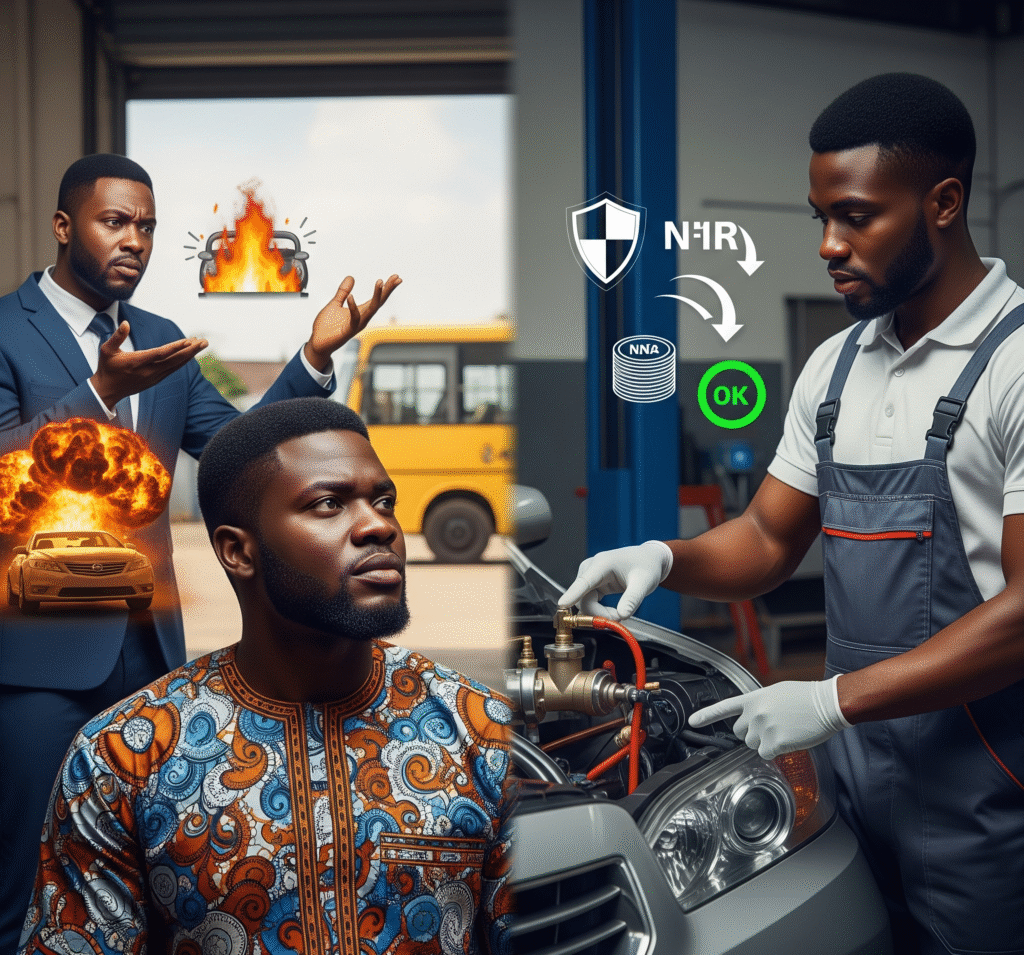
CNG in Nigeria: A Fact-Finding Mission on Safety, Conversions, and Your Peace of Mind
Since the price of petrol went through the roof, the letters “CNG” have been on everyone’s lips. From danfo drivers in Lagos to private car owners in Abuja, Compressed Natural Gas is being hailed in some quarters, as our saviour from crippling fuel costs. The government is pushing it, investors are building stations, and your neighbor might already be converting to a CNG powered car.
But alongside the buzz of excitement, there’s a whisper of fear. Viral videos of exploded cars, stories of horrific injuries, and rumours of “driving bombs” have made many Nigerians understandably nervous. Is this cheaper fuel worth the risk? Are we trading fuel costs for our safety?
This report is a fact-finding mission. We will cut through the noise, separate the hard facts from the fantastic claims, and give you the information you need to make a safe choice for yourself and your family. We will investigate what really happened in those explosions, what a safe conversion looks like, and what the government is actually doing to protect you.
Chapter 1: Is CNG a “Driving Bomb”? – Separating Fact from Fiction
Let’s tackle the biggest fear head-on: Is a CNG car inherently more dangerous than a petrol car?…… The simple, scientific answer is no. In fact, when international standards are followed, CNG vehicles are considered to be as safe as, or even safer than, their petrol-powered counterparts.
This isn’t just a claim; it’s based on the physics and chemistry of the fuel itself.
- Fact: CNG is Lighter Than Air. This is perhaps its biggest safety advantage. If a petrol tank leaks, the liquid fuel pools on the ground, creating a dangerous, flammable puddle that can easily ignite. If a CNG tank leaks, the gas, being lighter than air, doesn’t pool. It rises and disperses rapidly into the atmosphere, dramatically reducing the risk of a ground-level fire.
- Fact: CNG is Harder to Ignite. You’ve heard the rumours about our hot climate and bad roads making cylinders explode. But science tells a different story. CNG has a very high ignition temperature of about 540°C. Petrol, by contrast, can ignite at just 258°C. This means CNG is far less likely to catch fire from a hot engine surface in the event of a leak.
- Fact: CNG Has a Narrow Flammability Range. For CNG to burn, it needs a very specific mixture with air—between 5% and 15%. Too little gas and it won’t burn; too much gas and it won’t burn. Petrol has a much wider range, making it easier to accidentally create the right conditions for a fire.
Decades of use with over 15 million natural gas vehicles worldwide back this up. A major U.S. study found that natural gas vehicles had a 37% lower injury rate in accidents compared to similar petrol vehicles, with zero fatalities recorded. The technology itself is proven and safe. The danger, as we’ve seen in Nigeria, lies elsewhere.
Chapter 2: The Real Danger – The “Quack” Conversion and the Substandard Cylinder
If the technology is safe, why are we seeing explosions? The evidence from recent tragedies in Nigeria points to one clear and consistent culprit: dangerous, illegal, and substandard vehicle conversions.
The explosion at the NIPCO station in Benin City in October 2024 is a tragic but perfect case study. Investigations by both the company and the government’s Presidential CNG Initiative (PCNGi) concluded that the blast was caused by a “fake, fabricated, substandard unit not designed for CNG”. The cylinder had been illegally welded together by an unaccredited technician who was trying to cut corners.
This is the heart of the problem. A proper CNG cylinder is a highly engineered, seamless pressure vessel built to handle immense pressures of over 200 bar (about 2,900 psi). In contrast, a cooking gas (LPG) cylinder is designed for only about 7 bar of pressure and often has welded seams. Using a welded LPG cylinder, or a locally fabricated copy, for a high-pressure CNG application is like trying to carry a bag of cement in a thin nylon shopping bag. It is guaranteed to fail.
Similarly, the horrific truck crash on the Abuja-Keffi road in March 2025 highlights another critical issue. The FCT Fire Service reported that the initial cause was brake failure on the truck. This shows that even a perfectly safe CNG system is dangerous if the vehicle it’s installed in is not properly maintained. The problem wasn’t the gas; it was a poorly maintained truck that became a missile.
These incidents are not a failure of CNG technology. They are a failure of standards, regulation, and a direct result of people cutting corners to save money, with devastating consequences.
Chapter 3: Your Car, Your Life – A Guide to Safe Conversion
The single most important decision you will make in your CNG journey is how and where you convert your vehicle. Getting this right is the key to your safety.1. Choose a Certified Conversion Centre, Not a Roadside Welder.
The government, through the National Automotive Design and Development Council (NADDC), has begun certifying official conversion workshops.
Do not, under any circumstances, use an uncertified mechanic or welder. An accredited centre is your first line of defence.
- What to do: Ask the workshop for their official NADDC accreditation certificate. If they can’t provide it, walk away. There are now over 200 accredited centers in Nigeria, up from just seven a year ago.
2. Know Your Cylinder: How to Spot a Fake.
The cylinder is the most critical component. You must insist on a cylinder certified by the Standards Organisation of Nigeria (SON).
- What to look for:
- Seamless Construction: A real CNG cylinder has no visible welding seams. If you see a weld line, it’s a fake and extremely dangerous.
- The Official Label: A certified cylinder must have a permanent label with key information: the manufacturer’s name, the certification standard (look for “ISO 11439”), the service pressure (at least 200 bar), and, crucially, a “Do Not Use After” date. CNG cylinders have a lifespan of 15-20 years and must be decommissioned after they expire.
3. Understand the Cost.
A proper, safe conversion is not cheap. Costs can range from N700,000 to over N1.6 million, depending on your vehicle. While this is a huge investment, the tragic incidents show that the cost of a cheap, illegal conversion can be infinitely higher.
4. Check for Proof of Compliance.
After a certified conversion, your vehicle must have two things:
- An alterer’s label on the driver’s side door jamb.
- A QR Code issued by the NADDC-certified workshop. This code will be your vehicle’s passport to refuel at official stations under the new government monitoring system.
Chapter 4: What is the Government Doing? (And is it Enough?)
Faced with these safety challenges, the government is not sitting idle. A multi-agency plan is being put in place to regulate the entire CNG ecosystem, from the port of entry to the fuel pump.
- The Rulebook: The Standards Organisation of Nigeria (SON) has officially adopted 88 international standards for all CNG products, including conversion kits, storage cylinders, and refueling stations. This means there is now a clear, legal definition of what is safe and what is not.
- The Gatekeepers: The NADDC is in charge of accrediting conversion workshops and technicians, while the Nigerian Midstream and Downstream Petroleum Regulatory Authority (NMDPRA) is responsible for licensing refueling stations.
- The Digital Policeman: The most important development is the upcoming Nigerian Gas Vehicle Monitoring System (NGVMS). This is a centralized digital platform that will link everything together. In simple terms, when you drive into a refueling station, the attendant will scan your vehicle’s QR code. If your car was converted at a certified center with approved parts and is registered in the NGVMS database, you get fuel. If it was done illegally, the pump will not dispense gas. This system is designed to completely shut out the dangerous, informal market and is expected to be launched by the end of the year.
The challenge, however, is that these regulations are in a race against time. The system isn’t fully live yet, and the high cost of certified conversions might still pushes people toward dangerous alternatives.
Chapter 5: Living with Your CNG Car – A Simple Safety Guide
Once your car is safely converted, a few simple habits will ensure it stays that way.
- Trust Your Nose: Natural gas is odorless, so a “rotten egg” smell (from an additive called mercaptan) is put in so you can easily detect leaks. If you smell this, park your car in an open area away from ignition sources, shut off the engine, manually close the valve on the cylinder, and call your certified technician.
- Use Certified Mechanics: For any maintenance on the CNG system, always use a technician certified to work on CNG vehicles. Your regular mechanic may not have the required skills.
- Regular Inspections are Key: International standards recommend a detailed visual inspection of the entire high-pressure fuel system by a certified inspector at least every